
Every Kairos Deep-Dive starts the same way: we ask what a destination does to a student that nowhere else can. For Washington D.C., the answer is simple. It makes American history real.
You can teach the Civil Rights Movement in a classroom. You can read about the Constitution, project photos of the Lincoln Memorial, assign essays on the foundations of democracy. And all of that matters. But there is something that happens when a 16-year-old stands at the base of the Lincoln Memorial at dusk, reads those words carved into stone, and realizes they already know them, that no amount of classroom preparation can fully replicate.
D.C. is the closest thing the United States has to a living history museum. And for school groups, it’s one of the most content-rich destinations in the world.
What students actually do in D.C.
The question we always ask schools before building a D.C. itinerary is: what are you teaching right now?
Because the beauty of Washington is that it connects to almost every part of the curriculum.
Here’s a sample of what Kairos groups typically experience:
- The Smithsonian Institution: not just one museum but a complex of 19, covering American history, natural history, air and space, art, and culture. Free entry. Extraordinary depth.
- The National Archives: home of the Declaration of Independence, the Constitution, and the Bill of Rights. Students can stand within feet of the founding documents of the United States.
- The National Mall: a two-mile stretch connecting the Lincoln Memorial to the Capitol, lined with monuments that span 250 years of American history.
- The United States Holocaust Memorial Museum: a powerful, sobering, and deeply important stop for older students. Not suitable for all groups, but transformative for the right ones.
- The Martin Luther King Jr. Memorial, the Vietnam Veterans Memorial, and the Women’s World War II Memorial: each offering a different lens on American sacrifice and progress.
- Capitol Hill: depending on the timing and group, some Kairos schools have arranged visits to congressional offices or attended Senate observations.
D.C. for different subject areas
One of the things that makes Washington D.C. exceptional as a school trip destination is its versatility. It isn’t just a history trip:
- History and civics classes will find decades of curriculum brought to life across the Mall and the Archives.
- Political science and government students can observe the machinery of democracy in action: congressional hearings, the Supreme Court, the Library of Congress.
- Art and culture groups have access to the National Gallery of Art, one of the finest collections in the country and free.
- Science classes can explore the National Museum of Natural History and the National Air and Space Museum in depth.
This cross-curricular reach makes D.C. one of the easiest destinations for trip coordinators to justify to a curriculum committee.
Logistics: what makes D.C. manageable for school groups
Beyond its content, D.C. is genuinely practical for school travel:
- Almost all the major attractions are free, which significantly reduces per-student costs.
- The city is compact and walkable, most of the Mall and Monument areas are within easy walking distance of each other.
- There are strong accommodation options across a range of budgets, from standard hotels to university dormitories during summer breaks.
- D.C. is well-connected by air from across the country, making it accessible for schools in almost any state.
When to go
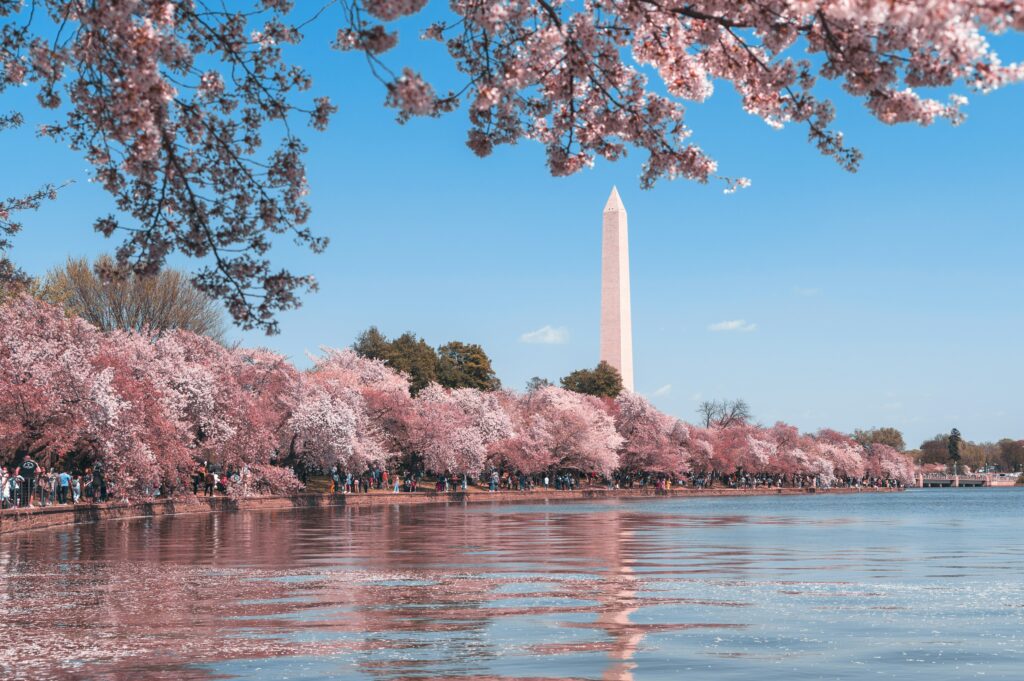
Spring (April–June) is peak season for school groups, and for good reason, the weather is pleasant, the cherry blossoms (in early spring) are spectacular, and the city has an energy that matches student enthusiasm. Book early if you’re targeting this window.
Fall is an equally strong option with cooler weather, fewer crowds, and the added benefit of the city returning to political life after summer recess, which adds to the civic atmosphere.
What the Kairos D.C. experience looks like
Our D.C. itineraries are built around your school, not a generic template. We start with your curriculum, identify the stops that will land hardest with your students, and build a day-by-day plan that balances structure with discovery.
Our guides in D.C. are educators themselves. They know how to work with student groups, how to pace a day, and how to turn a monument into a conversation.
If you’re considering D.C. for next year or want to know what a Kairos itinerary looks like, get in touch. We’ll send you a sample schedule and talk through what’s possible for your group.
